


Bura is a cold, strong, dry wind from the northeast that forms when cold air from the mainland mountains (Velebit and Ćićarija) crosses the Adriatic. Baška has around 80 bura days a year — 83 were recorded in 2025, including 55 with storm-force gusts. They are most frequent in January, February and November. In summer (June–September), bura is less common, with two to seven days per month; it usually lasts a day or two and is forecast 24–48 hours ahead.
This guide helps you understand the colours in the forecast widget on our homepage — and what to do when bura really arrives.
How to Read Our Forecast
On the homepage, you will find the “Bura frequency · 7 days” — seven mini-bars showing the expected intensity for each day. The data comes from the official DHMZ Meteoalarm CAP feed, the same source used by all Croatian weather services.
Calm
up to 20 km/h in gusts
Everything is normal — beaches, kayaking, SUP, diving and boat trips.
Moderate
20–50 km/h in gusts
Vela plaža has waves; choose sheltered coves such as Bunculuka and Zablaće. For boat trips outside the bay, check with the captain.
Strong
50+ km/h in gusts
The Baška–Lopar catamaran is usually suspended. Krčki most is occasionally closed to lorries and vehicles with trailers. Skip the beaches.
What to Do by bura Strength
When It Is Calm
Everything is normal. Vela plaža, diving, kayaking, SUP and boat trips around the cape towards Lopar and Cres are all available. Make the most of the day.
When It Is Moderate
- Beach — Vela plaža has waves, but swimming is possible. Choose the sheltered Bunculuka and Zablaće.
- Boat trips — not around the cape towards Lopar; shorter trips within the bay are possible if the captain confirms.
- Kayaking and SUP — for experienced people only, no more than 500 m from shore.
- Diving — only in sheltered coves (Bunculuka).
When It Is Strong — Plan B
- Hike to Camel Point or Vrh Baške — see bura at full strength, but safely: the trail is sheltered.
- Diving course in a sheltered cove — Bunculuka and the cove near Zablaće are the calmest.
- Gastro day — visit the restaurants and konobas you have been saving for later. The konobas in the old town are sheltered from bura.
- Trip to Krk town or Vrbnik — Vrbnik for konoba Nada in the wine cellar; Krk town for a walk and coffee on Vela placa.
How to Prepare
- Clothing — even in summer, bring a light windbreaker and long trousers on bura days. The sun stays strong, but the wind is cooling.
- Hat and sunglasses — essential; the sun is stronger when the air is clear.
- Car — close all windows and park it away from trees.
- Roof-mounted bike — remove it before crossing Krčki most in bura.
- Terraces — restaurants may lower parasols and awnings; sit inside when it is strong.
Signs That bura Is Coming
Locals recognise bura before they open the forecast. You can spot the six signs below from a café terrace. When four appear together, bura is already here.
A cap of cloud over the peaks
A still white cap hangs over Hlam and Obzova while the sky is clear everywhere else.
Masts ringing
In the harbour, cables strike the masts. You can hear the sound from the shore.
Velebit in sharp relief
The air is so dry and clear that every detail of the serrated ridge across the channel is visible.
Whitecaps at sea
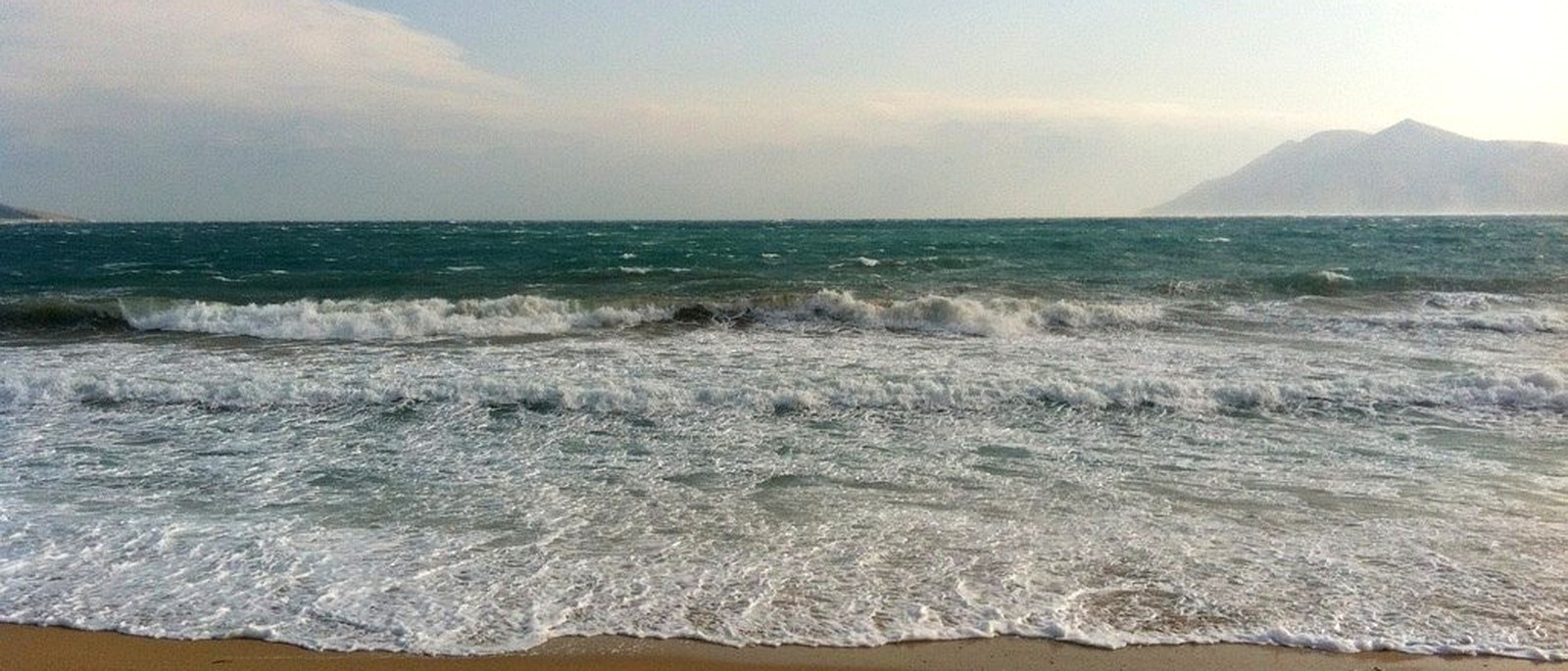
Off Vela plaža, the sea breaks into white streaks travelling from shore towards open water.
Folded parasols
Terraces on the Riva fold away awnings and parasols, and tables move into shelter.
The catamaran is not running
The Baška–Lopar service does not depart. It is the clearest sign that bura has exceeded 50 km/h in gusts.
Bura Chronicle in Baška
The figures below are neither estimates nor copied from elsewhere. They are calculated from hourly readings for a point above Baška, recalculated every six hours, so the current year fills itself in as the season progresses.
Strongest episodes
Longest episodes
A day with bura means that for at least one hour the mean wind was 29 km/h or stronger and came from the north-eastern sector. A stormy day means that at least one gust exceeded 62 km/h. An episode is an uninterrupted sequence of hours with bura; there are 165 in the measured period. The source is the Open-Meteo archive for the point above Baška.
Bura Myths vs Facts
Myth: “When bura blows, the sea is always cold.”
Fact: The sea cools only after two or three days of strong bura. On the first day, swimming is often still possible.
Myth: “bura is dangerous to your health.”
Fact: bura brings exceptionally clean, dry air — many find it refreshing. The temperature changes suddenly, so a light jacket is a good idea.
Myth: “There is no bura in summer.”
Fact: There is, but it is rarer and shorter. July usually has one or two bura days.
Interesting Facts
Record gust at Krčki most, measured on 6 February 2015. The bridge was then closed to all traffic.
The previous record at the same bridge, on 11 November 2013, during a cyclone named Teodor.
Croatian record at Maslenički most, December 1998. It remains the country’s strongest officially measured bura gust.
This share of Rijeka’s wind rose belongs to the east-northeast direction, from which bura arrives.
Average duration of one bura episode in December, measured in Senj. In July it is 8.7 h.
Average annual number of days with storm-force bura in Senj, the windiest place on the Adriatic.
Krčki most closes progressively by vehicle group. First comes Group I — motorcycles, curtain-sided lorries, vehicles with trailers and caravans — then Group II, which includes vans and cars with roof racks. If you are travelling with bikes on the roof, remove them before the bridge in bura.
Bura is such a part of Baška’s identity that local legends say, “you have to wait three days for bura to pass.” A local saying holds that bura lasts 1, 3 or 7 days.
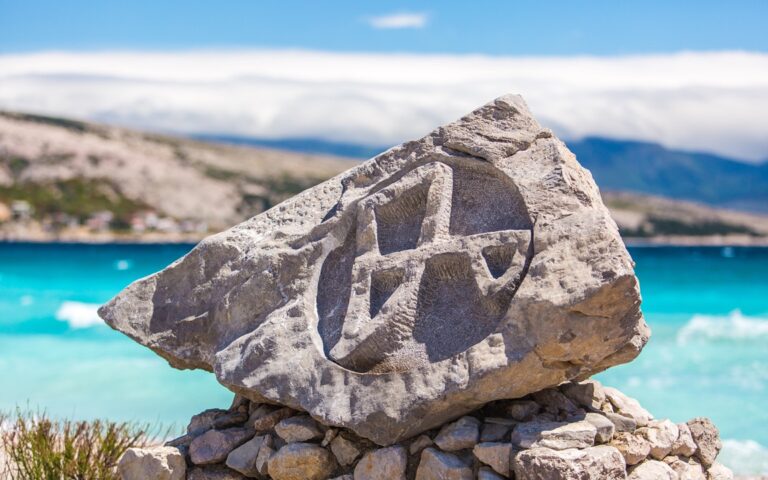
The authors of Baščanska ploča (11th century) — the most important monument of Croatian literacy, found near Jurandvor — probably lived to the rhythm of bura. Today, Baščanska ploča is held at the Croatian Academy of Sciences and Arts in Zagreb, while a copy stands in St Lucy’s Church in Jurandvor.
Sources for the figures
- Krčki most record of 224 km/h, 6 February 2015 — tportal, Večernji list
- Gust of 221.8 km/h, 11 November 2013 — Crometeo
- Croatian record of 248 km/h, Maslenički most, December 1998 — Faculty of Science, Department of Geophysics
- Rijeka wind rose: 36 % from ENE — Climate Atlas of Croatia, DHMZ
- Monthly duration of bura in Senj — Lukšić, Hrčak
- Storm-force bura in Senj, more than 20 days a year — Jadran, Department of Geophysics
- Cold and warm parts of the year; episode duration — Keresturi, thesis
- Three March buras — Crometeo
- Bura chronicle, hourly data for a point above Baška, 2025 and 2026 — Open-Meteo, historical forecast API
- Current wind in the banner — Open-Meteo, forecast API
- Krčki most closures by vehicle group — Bodulija