


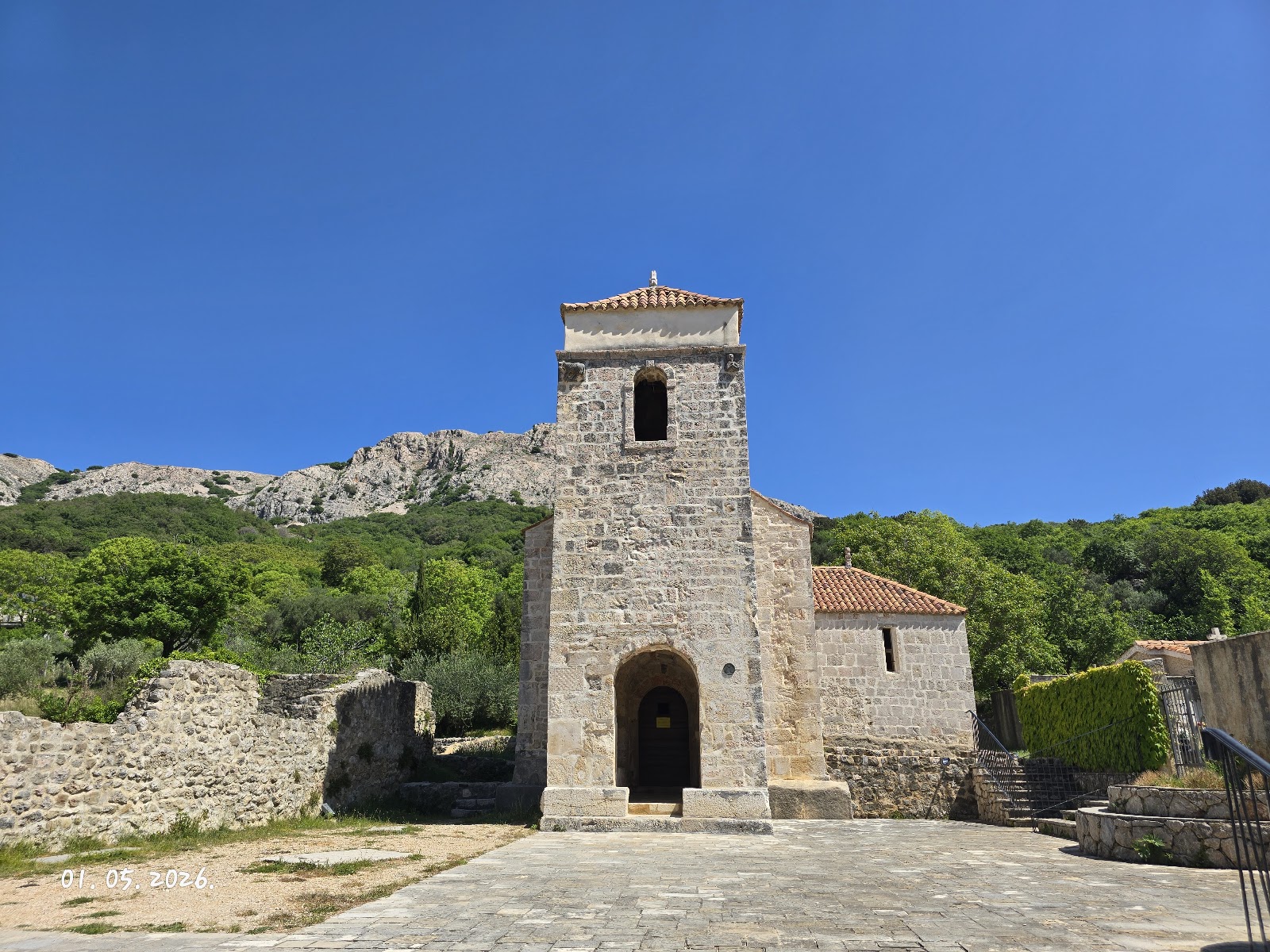
The place where the written history of the Croatian language begins
In a small church in Jurandvor, there stood a tablet on which, around the year 1100, the Croatian name was first written in the Croatian language and in Glagolitic script. Around it, the entire valley is full of layers: a Roman villa rustica, a Benedictine abbey, a burnt medieval castle, a Baroque parish church, a sanctuary with 237 steps, and dry-stone sheepfolds almost unique in the world.
Bašćanska dolina nije jedno mjesto nego četiri naselja u nizu. Baška je na moru, Jurandvor je dva i pol kilometra unutar doline, Draga Bašćanska leži dublje u polju, a Batomalj se drži brda nad njim. Svako od njih nosi dio istoga naslijeđa i sva se mogu obići u jednom danu, pješice ili biciklom, jer između njih nema više od pola sata hoda.
Najstariji sloj je u Jurandvoru. Ispod crkve sv. Lucije arheolozi su našli rimsku villu rusticu i ranokršćansku baziliku iz 6. stoljeća, a nad njima su benediktinci oko 1100. sagradili crkvu u kojoj je stajala Bašćanska ploča. Najviši sloj je na brdu iznad Baške, gdje se od srednjovjekovnog kaštela sačuvala samo crkva sv. Ivana Krstitelja i nekoliko zidova, ali i najbolji pogled na dolinu.
Draga Bašćanska je najplodniji dio te doline i po tome je poznata. Odande dolaze pomidori kakvih nema drugdje na otoku, a svakog 16. kolovoza selo slavi Rokovo, feštu na dan svog zaštitnika svetog Roka. Kako je Vela Gospa dan prije, u Batomlju, ta dva datuma zajedno čine najbogatiji vikend u godini u cijeloj dolini.
Ono što tu baštinu drži živom nisu samo kamene građevine. Na sv. Luciju, 13. prosinca, sa zvonika u Jurandvoru i danas se baca maleni kruh zvan hlipčić. Na Velu Gospu, 15. kolovoza, hodočasnici uz svijeće nose kip Majke Božje stubama iznad Batomlja. Suhozidne ovčare u visoravni gradili su pastiri iz Baške, Batomlja i Jurandvora, a njihovo umijeće danas je na UNESCO-ovu popisu.
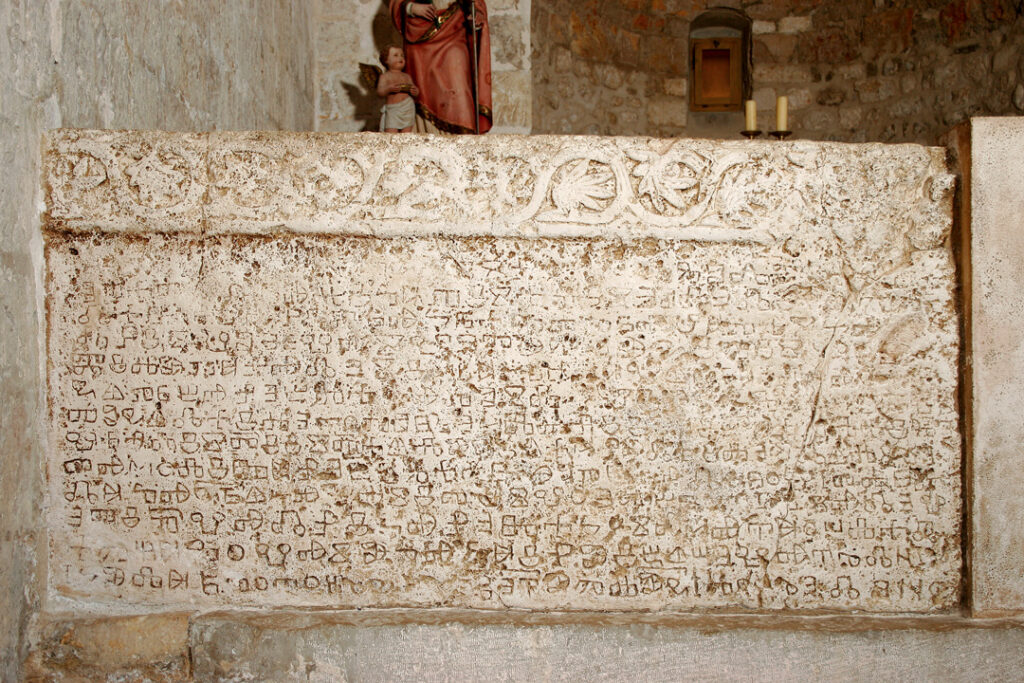
The Birth Certificate of the Croatian Nation
Bašćanska ploča — the stone that marks the beginning of Croatian literacy
White limestone, one meter high and two meters wide, originally gilded and painted. In thirteen lines of Glagolitic script, it states that Croatian King Dmitar Zvonimir donated land to the Benedictine monastery in the name of St. Lucy. This is the oldest known document in which the Croatian name is inscribed in the Croatian language and Croatian script.
The tablet was never intended as a monument. Until the mid-18th century, it was the left partition slab of the stone barrier that divided the monastic choir from the faithful in the nave of the Church of St. Lucy. When that partition was demolished after 1752, the tablet was laid on the floor and walked upon, and even used for burials. That is why its letters are worn in places.
It was discovered on September 15, 1851, thanks to the then theology student Petar Dorčić, who informed Ivan Kukuljević Sakcinski about it. Ten years later, Krk canon Ivan Črnčić found it in the side chapel of Our Lady of the Rosary, where Bishop Vitezić had it placed. It had cracked into three pieces, so Bishop Feretić had it bound with an iron hoop.
The most dramatic episode was its departure from Jurandvor. In 1934, Bishop Josip Srebrnić gave it to the Academy for permanent safekeeping, but some locals did not accept this. On the night of August 16-17, they moved it themselves to the new school, where they wanted to embed it in the floor, and in doing so damaged it further. Ivšić took it over for the Academy on August 30; it left by steamship for Sušak and arrived in Zagreb the next day. In Zagreb, it was washed for 226 days to remove the salt that was corroding it.
Today, the original is in the atrium of the Academy palace in Zagreb, and a replica stands in the Church of St. Lucy. According to the 1934 agreement, the tablet remains the property of the Abbey of St. Lucy, or the Diocese of Krk, while the Academy has only the duty of safekeeping.
Little things easily missed
The text has about 400 letters and one hundred words. The word "Bog" (God) is the fiftieth in order and stands exactly in the middle of the seventh line. The inscription begins with the letter A and ends with the letter O, the first and last letters of the Greek alphabet. It is written in a transitional type of Glagolitic script, from round to angular, and also features Latin and Cyrillic letters.
- 99,5 × 199 cm
- 13 redaka, oko 400 slova
- Opati Držiha i Dobrovit
- Original u HAZU, replika u Jurandvoru
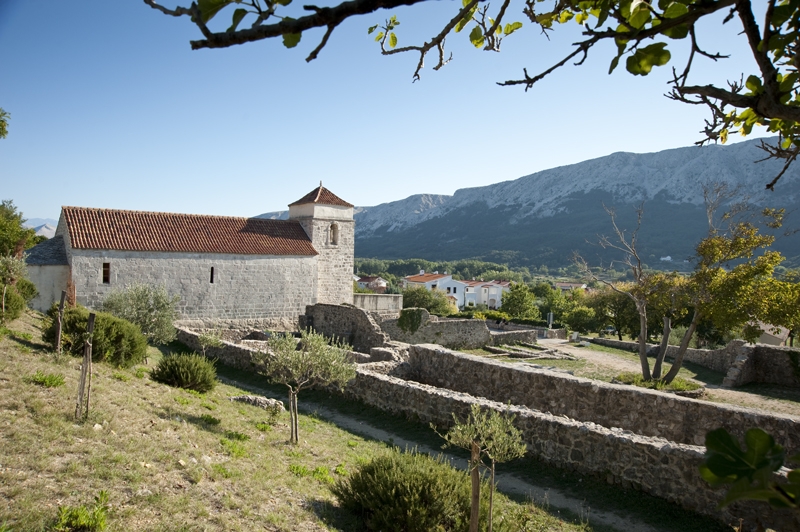
Jurandvor, 2.5 km from Baška
Abbey of St. Lucy — the church built by Abbot Dobrovit
A single-nave early Romanesque church with a semicircular apse, built around 1100. The tablet itself states that Abbot Dobrovit built it together with nine monastic brothers, during the time of Prince Kosmat. Rarely does a church in Croatia have the name of its builder inscribed in stone within its own building.
The bell tower is on the facade and has its own master. In the 13th century, it was built by Andrija from Krk, who left the inscription MAISTER ANDREAS ME FECIT on it. In 1863, Bishop Vitezić lowered the bell tower by one floor and incorporated symbols of the four evangelists into it. The bell tower also has a carved checkerboard, which is cited in the literature as possibly one of the earliest depictions of the Croatian coat of arms.
The church is still part of the abbey estate. In 1498, the Juranić family added the chapel of Our Lady of the Rosary, where the tablet was hidden for a time. The Benedictines left here in 1465 for Italy, and since 1817 the church has belonged to the Diocese of Krk, so the bishops of Krk still bear the title of Abbot of St. Lucy. The valuable polyptych painted by Paolo, Luka, and Ivan Veneziano is no longer here but in the bishop's palace in Krk.
Around the church, an archaeological park has been arranged since 2000 with excavated foundations of a Roman villa rustica and an early Christian basilica, and in the lapidarium are stone fragments with Glagolitic letters. A replica of Bašćanska ploča stands inside, in a position that gives a good idea of how the original partition divided the space.
Hlipcići, December 13
On St. Lucy's Day, small bread rolls called hlipcići are thrown from the bell tower. This custom is linked to the former mill on Suha Ričina, the only permanent river on Croatian islands, which flows through the Baška valley.
Church of St. Lucy, Jurandvor
Protected Cultural Property- Address
- Jurandvor b.b., 51523 Baška
- Phone
- +385 51 860 184
- [email protected]
- Register
- Z-5335 (church), Z-5765 (tablet)
- Oko 1100.
- Majstor Andrija iz Krka
- Arheološki park od 2000.
- Replika ploče u crkvi
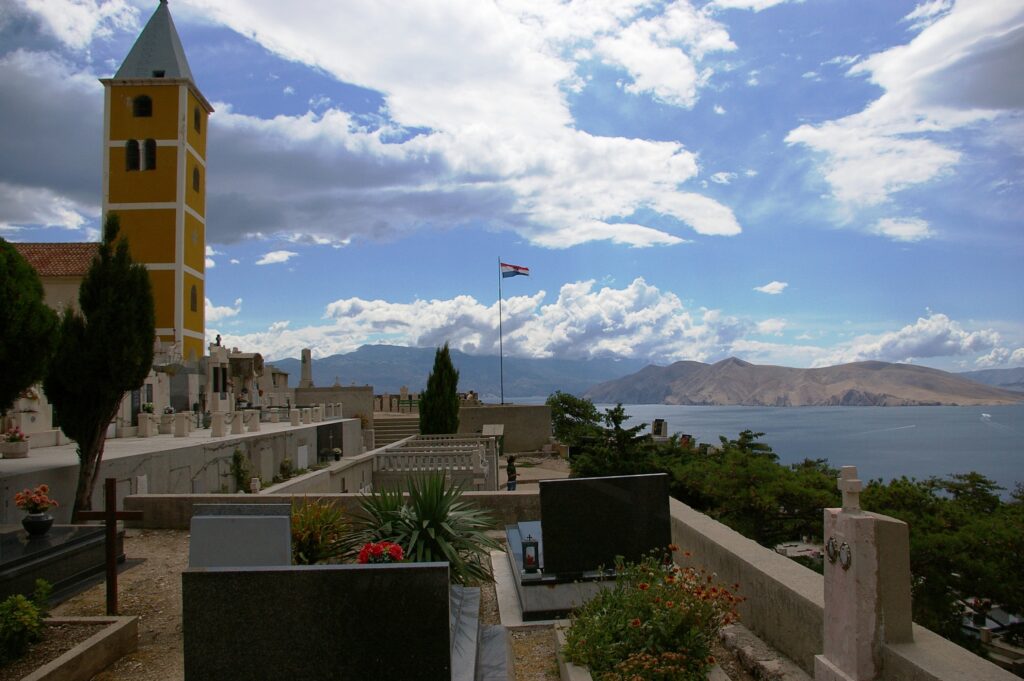
Best Viewpoint over the Valley
St. John the Baptist and the ruins of Baška castle
Twenty minutes uphill from the center, along an asphalt road mostly in the shade, stands a white bell tower next to an old cemetery at about a hundred meters above sea level. This is the Church of St. John the Baptist, the first parish church of the medieval Baška castle, and today a place from which the most recognizable photos of the town were taken.
The castle is mentioned in sources from the 13th century, and it housed a magnificent building with seven altars. The Venetians burned it in 1380, during the war with King Louis, and this, together with the plague, forced the inhabitants to move down to the sea, to present-day Baška. The church was a parish church until 1740, abandoned in the 19th century, and restored in 1855 after a cholera epidemic.
The bell tower, as in Jurandvor, is on the facade, and it contains a bell called Starac (Old Man), cast in 1431. Today, the bell is in a side room that serves as a small gallery dedicated to St. John. A few minutes away are the ruins of the 13th-century Church of the Holy Spirit and the remains of walls, so the entire abandoned settlement on the hill can be visited in one circuit.
The cemetery by the church has its own story. Here rests Emil Geistlich, a Czech who first visited Baška in 1909 and then opened a pavilion in Zablaće, arranged a hotel, and printed the first tourist brochure about the place. Without him, Baška tourism would not have started when it did.
From the viewpoint, you can see the entire valley, the island of Prvić across Senjska vrata, and the full length of Vela plaža. From here also begins the most popular Baška walking trail, the one to Moon Plateau.
Starting point of the promenade to the Moon
From Hotel Forza through St. John to the Moon Plateau is about 4.5 kilometers and an hour and fifteen minutes walk, with a 370-meter ascent. The last three kilometers go through a pine forest, and the plateau is entered through an inlet in the dry-stone wall. If you continue to the top of Hlam, it's a total of 7.5 kilometers and about three hours.
- Oko 100 m n. v.
- Zvono „Starac“, 1431.
- Kaštel spaljen 1380.
- 20 min hoda iz centra
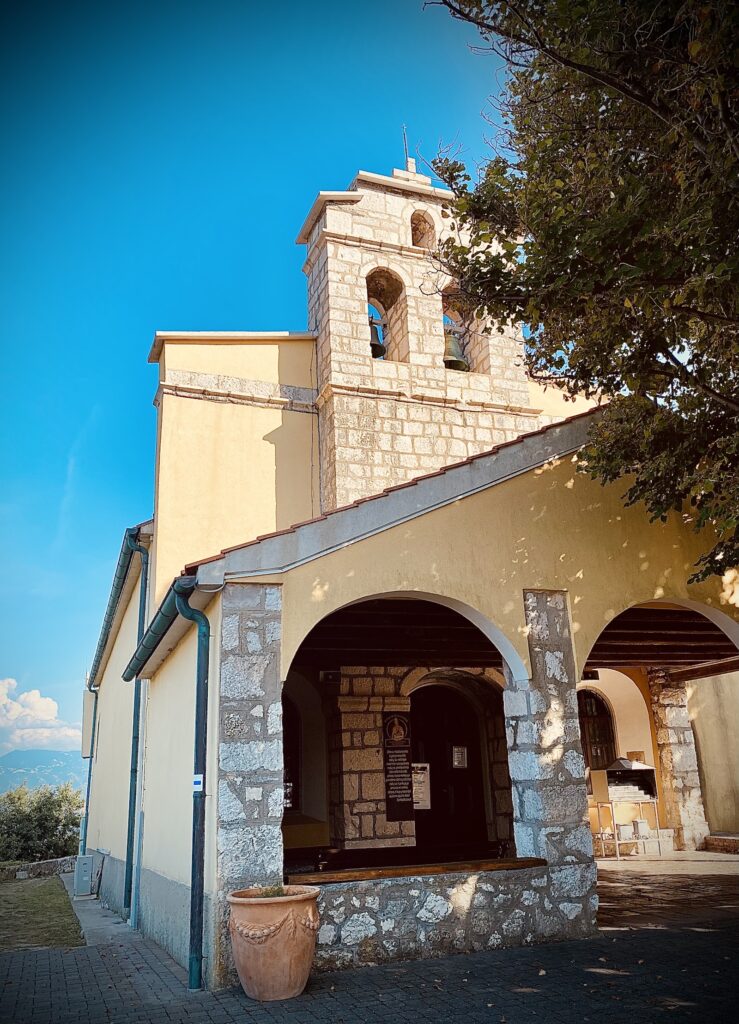
Batomalj, 237 steps uphill
Sanctuary of Our Lady of Gorica
The most important Marian sanctuary on Krk stands above Batomalj, and 237 votive steps with Stations of the Cross lead to it. The steps were built by locals and pilgrims from the late 19th century, and the Stations were blessed in 2003.
The legend explains both the name and the place. Children, the legend says, found Mary's statue on the hill of Gradac, where there are remains of a Liburnian hillfort, three times, and the third time the statue stood on snow. The original sanctuary from the 11th century was on Goričica below St. Lucy, and the church got its name from it. The present building is from the 15th century, and it was consecrated in 1550 by Krk Bishop Albert Dujam de Gliricis.
The statue venerated here is a Venetian work from the late 15th or early 16th century, polychrome wood, a crowned Madonna with a sleeping Child. On the altars are paintings by Celestin Medović, and among the votive offerings is a watercolor by Kvirin Desantić from 1861, depicting rescue from Turkish captivity. According to legend, those shackles were reforged into the hinges on the church doors.
From Gorica also comes one of the most important Croatian Glagolitic documents. The Statute of the Fraternity of Our Lady of Gorica from 1425 is the oldest fraternity statute in Croatia written in Glagolitic script, and among the fraternity members were the Frankopans. Two sheets of that manuscript are now in the Schøyen Collection at the National Library in Oslo.
Vela Gospa, August 15
The main pilgrimage is on Vela Gospa (Assumption Day). The vigil begins on August 14 at 8:30 PM, when the statue is carried up the steps with candles. This is the most visited day of the year at the entire sanctuary, so plan your arrival in advance.
- 237 zavjetnih stuba
- Crkva iz 15. stoljeća
- Zakon brašćine, 1425.
- Hodočašće 15. kolovoza
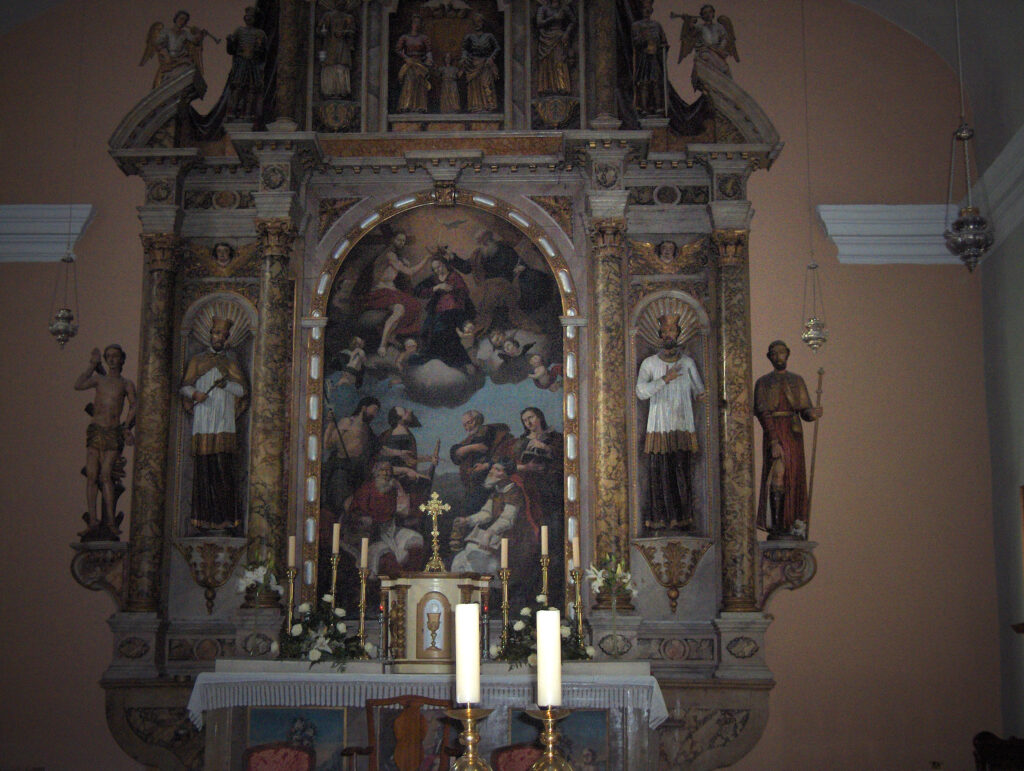
Old Town of Baška
Parish Church of the Holy Trinity
When the inhabitants moved from the hill to the sea, they needed a new parish church. The Holy Trinity was consecrated in 1723, and three centuries later, in 2023, its jubilee was celebrated in Baška. It is Baroque, three-nave, 43 meters long and 16 meters wide, with a nave height of twelve meters.
Inside are eight altars. The main one is the work of local master Frano Jurić from the 18th century, and on it is the Coronation of the Mother of God from 1724. Among the paintings are those attributed to Andrea Mantegna from the late 15th century and The Last Supper by Jacopo Palma the Younger. From the older heritage, early Romanesque capitals are incorporated into the church, and the inventory includes a silver cross of the Frankopans from the 15th century.
The bell tower was completed in 1766 and is 28 meters high, so it is visible from most of the coast. That Baška was a church center at that time is also evidenced by the number of priests: at the beginning of the 18th century, the local chapter had up to sixty of them. It was dissolved at the beginning of the 19th century.
The church stands in the street network of the old core, which is itself protected as a cultural-historical entity. A short walk along Ulica kralja Zvonimira shows the stone coats of arms of old Baška families and carved details on the houses, so a visit to the church is easily combined with a tour of the old core.
- Posvećena 1723.
- Osam oltara
- Zvonik 28 m, 1766.
- 43 × 16 m
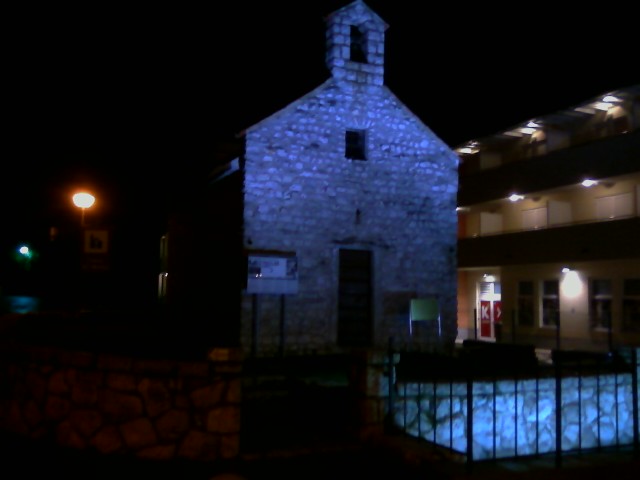
At the western end of Vela plaža
Chapel of St. Mark and the ancient mosaic beneath it
The small Romanesque chapel from 1514 stands a few steps from the beach and is easily passed without stopping. Beneath it, however, is one of the most interesting archaeological sites in the town.
Excavations here have uncovered an ancient mosaic, remains of a 5th-century basilica, and an early Christian baptistery. The site shows that the bay was inhabited and developed long before the medieval castle on the hill, so the history of Baška is read not only from top to bottom but also from the coast inward.
The chapel now serves as an exhibition space and sacred museum, which means that the site and objects can be seen inside, not just read on a plaque. As the program changes by season, it is wise to check before arrival whether it is open.
The chapel's location itself easily fits into a day at the beach. From it to the old core and the parish church is a few minutes' walk along the coast, so this is the shortest cultural tour that Baška offers.
- Romanička, 1514.
- Bazilika iz 5. stoljeća
- Antički mozaik
- Izložbeni prostor
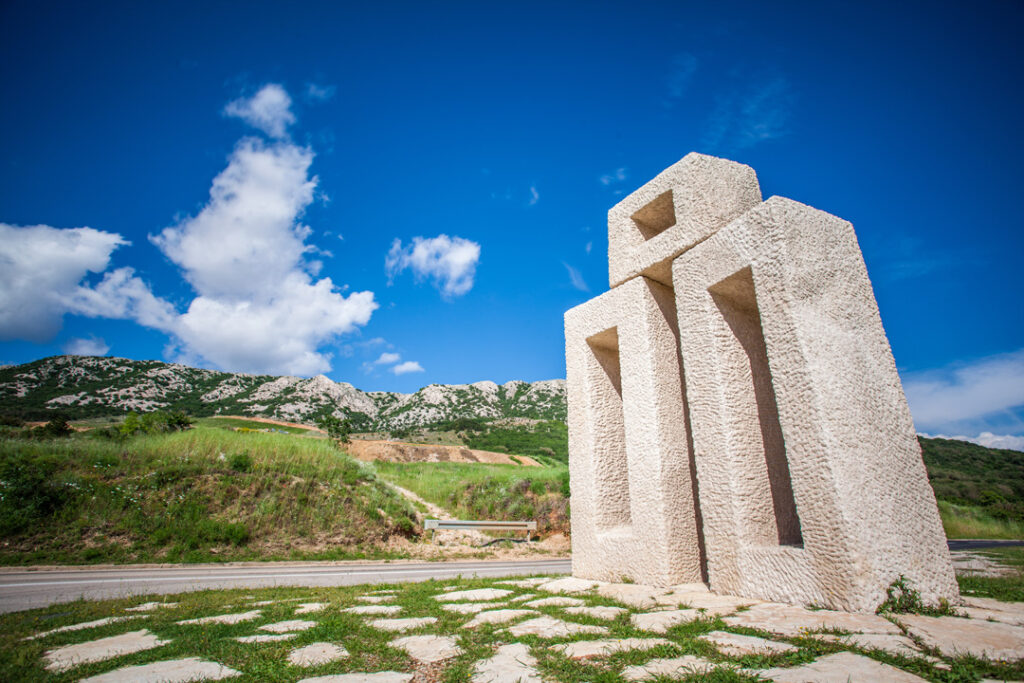
From Treskavac to Cape Kricin
Baška Glagolitic Path
If the Bašćanska ploča is the stone from which Glagolitic script in Baška begins, the Glagolitic Path is its continuation in modern times. Thirty-four stone sculptures with Glagolitic letters are arranged throughout the valley, along with another dedicatory one signed S-SINJALI.
The project was launched in 2006 by the local society Sinjali, and the path was opened in 2009. The four largest sculptures are the work of academic sculptor Ljubo De Karin, while the others were made by students in workshops in Baška. Each letter is dedicated to one Croatian city that donated it.
The first and largest is the letter A on Treskavac. It was erected on December 13, 2006, on St. Lucy's Day, is 6.10 meters high and weighs 17 tons, making it the largest stone monolith in Croatia. It is dedicated to Zagreb.
The path is not linear, and that is part of its character. From Treskavac it goes along the main street, then to Draga Bašćanska, Batomalj, and Jurandvor, then back to the beach and the harbor, to St. John, and finally to Cape Kricin in front of Bunculuka. Children collect letter imprints along the path and receive a diploma for a completed set.
Sinjali Society
Organizer of the path- [email protected]
- Phone
- +385 91 185 6533
- 34 slova i posvetni znak
- Slovo A: 6,10 m, 17 tona
- Ljubo De Karina
- Diploma za djecu
Flowers of Stone
Mrgari — dry-stone sheepfolds almost unique in the world
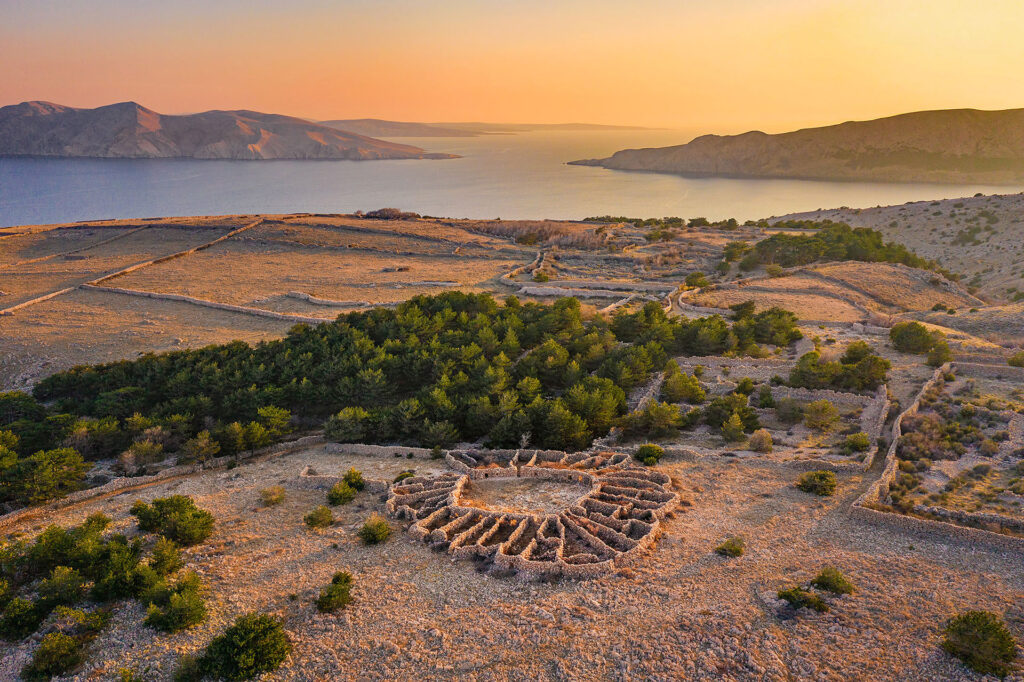
From the air, they look like a flower: a central circle with petals around it, all made of stone stacked without binder. These are mrgari, multi-chamber sheepfolds into which shepherds drove mixed flocks to sort them by owner. The same types of structures are known only in Wales, Iceland, and here.
There are fifteen in total. Five are on the southwestern and five on the northeastern plateau above Baška, and another five on the island of Prvić. They lie above 300 meters above sea level, in the rocky terrain that was used as common pasture, and the largest can hold up to 1,500 sheep. They were built by shepherds from Baška, Batomalj, and Jurandvor.
The art of dry-stone walling was inscribed in 2018 on UNESCO's list of intangible cultural heritage, and in 2024 the inscription was expanded and renamed and now includes thirteen countries. The mrgari are also nationally protected, in the Register of Cultural Goods under the designation Z-6878.
They are reached on foot, along marked trails toward Moon Plateau and the surrounding ridges. The shape is best seen from a height, so it is worth coming to the ridge instead of standing at the very edge of the enclosure. On the plateau is also the installation Kapi (Drops), the work of Chilean authors Smiljan Radić and Marcela Correa, placed on Ljubimer hill.
The rocky terrain requires preparation
There is no shade, no water, and no signage except for trail markers. For venturing into the highlands, sturdy footwear, a hat, and enough water are needed, and in mid-summer, it's best to start early in the morning.
- 15 mrgara ukupno
- Do 1500 ovaca
- UNESCO 2018. i 2024.
- Registar Z-6878
Baška Aquarium
Opening Hours and Prices- Address
- Ulica kralja Tomislava, 51523 Baška
- April and October
- 10 AM – 3 PM
- May, June, and September
- 10 AM – 5 PM
- July and August
- 9 AM – 9 PM
- Adults
- €7.00
- Children 3 – 12 years
- €5.00
- Children under 3 years
- Free of charge
- Phone
- +385 51 856 052
- Mobile
- +385 98 211 630
- [email protected]
In the town center, good for a rainy day
Baška Aquarium — Adriatic underwater world in twenty-one tanks
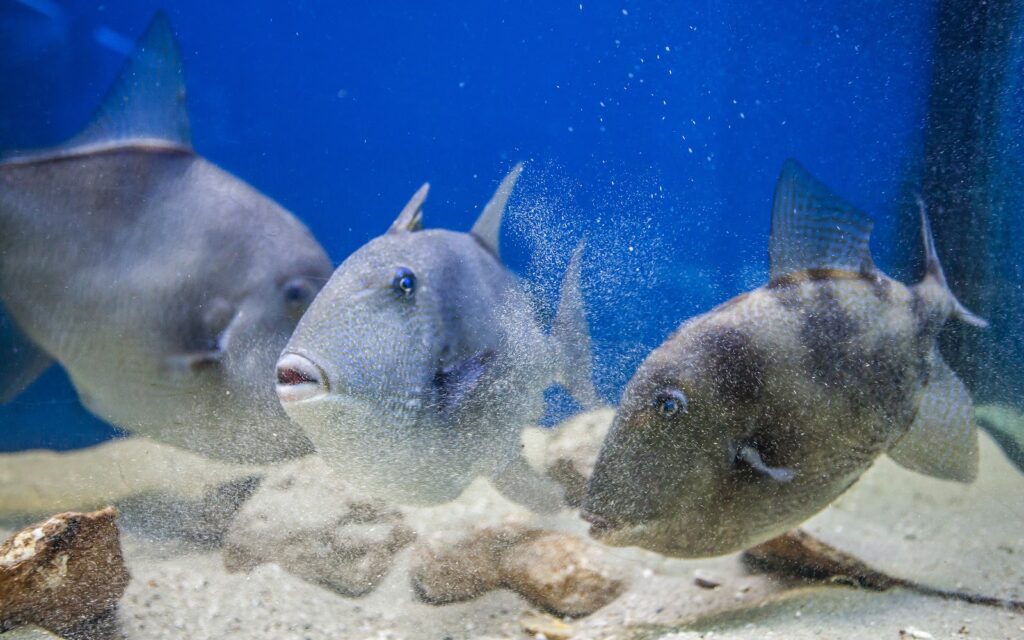
On two hundred square meters in King Tomislav Street, there are twenty-one tanks with a total of 35 cubic meters of seawater. They house over a hundred species of Adriatic fish, and next to the tanks is one of Croatia's largest collections of Adriatic shells and snails, about four hundred species.
You see what really swims beneath the surface in Baška, only up close: stingray, moray eel, scorpionfish, lobster, and octopus. The collection of shells and snails is part of the same display and explains how much more diverse the Adriatic seabed is than what is seen from the shore.
The tour lasts between half an hour and an hour, so it easily fits into a walk through the old core or an afternoon break from the beach. Children go through it slowly, so it is good to count on the longer end of that time. There are a few parking spaces right in front of the entrance, and paid parking is about thirty meters away.
The aquarium is run by the tourist agency Šiloturist and is open from April to October. For November and the winter months, opening hours are not published, so arrival out of season should be checked by phone. For groups, the price is negotiated by inquiry; there is no public price list for groups.
- 21 bazen, 35 m³ mora
- Više od 100 vrsta riba
- Oko 400 vrsta školjki i puževa
- Obilazak 30 – 60 minuta
What's Where in the Valley
Nine sites in a row from the sea to the highlands. Clicking on a marker opens a short description.
- Main Sites
- Sacred Heritage in the Town
- Ruins and Archaeology
- Glagolitic Path
- Dry-stone Heritage
- Aquarium and Collections
Nineteen Centuries in One Valley
From Roman villa rustica to UNESCO list. Years are listed as provided by the sources at the bottom of the page.
| Godina | Što se dogodilo | Gdje |
|---|---|---|
| 6. stoljeće | Early Christian basilica built on the foundations of a Roman villa rustica | Jurandvor |
| oko 1100. | Abbot Dobrovit builds the Church of St. Lucy, Bašćanska ploča is created | Jurandvor |
| 13. stoljeće | First mention of Baška castle, with the Church of St. John the Baptist next to it | Baška, hill |
| 1380. | Venetians burn the castle in a war with King Louis | Baška, hill |
| 1415. | According to tradition, a statue of Our Lady was found on Gradac hill | Batomalj |
| 1425. | Law of the Brotherhood of Our Lady of Gorica, the oldest statute of a brotherhood in Croatia | Batomalj |
| 1431. | The bell "Starac" (Old Man) was cast, now in the gallery next to the church | St. John |
| 1465. | Benedictines leave Jurandvor for Italy | Jurandvor |
| 1498. | The Juranić family adds to the Chapel of Our Lady of the Rosary | Jurandvor |
| 1514. | Romanesque Chapel of St. Mark built by the beach | Baška |
| 1723. | The Parish Church of the Holy Trinity is consecrated | Baška |
| 1766. | The bell tower of the Holy Trinity, 28 meters high, is completed | Baška |
| 1851. | Bašćanska ploča found in the Church of St. Lucy | Jurandvor |
| 1934. | The tablet is handed over to HAZU for safekeeping and transported to Zagreb | Jurandvor — Zagreb |
| 2006. | The first letter of the Baška Glagolitic Path is placed | Treskavac |
| 2018. i 2024. | Dry-stone construction inscribed on UNESCO's list of intangible heritage | Croatia and 12 other countries |
Drag the table sideways to see the column with the location.
Museums, Gallery, and Old Town
Smaller attractions that easily fit into a tour of the town.
Homeland Museum
Opened in 1970 in the house of teacher Nikola Pajalić, with an ethnographic collection and a memorial room for Czech physician Dr. Zdenka Čermakova. The museum is temporarily closed for reconstruction, so check in advance for availability.
Zvonimir Gallery
Exhibition space at King Zvonimir Street 114, with a program from May to October. It is the closest permanent address for contemporary exhibitions in the town.
Coats of Arms in the Old Town
In King Zvonimir Street, the coat of arms of the Desantić family is preserved at number 20 and the de Ponte coat of arms at number 18, while lion heads are carved on the balustrade of house number 8. The entire core is protected as a cultural-historical entity, Z-2699.
Church of St. Nicholas, Batomalj
Built in 1676, in the village itself below the sanctuary. It fits into the visit to Gorica as it is on the way, before the start of the votive steps.
Practical Tips for Visiting
Two Dates That Change the Day
Vela Gospa on August 15 in Batomalj and St. Lucy on December 13 in Jurandvor. On these days, the sites are crowded, the program is richer, but access is also more difficult. If you want peace, avoid these days.
Jurandvor without a car
The Church of St. Lucy is two and a half kilometers through the valley. It's about a half-hour walk, ten minutes by bike, and the path follows the same route as part of the Glagolitic Path.
Rokova in Draga Bašćanska
Draga Bašćanska celebrates its patron saint, St. Roch, on August 16. The festival is the day after Vela Gospa in Batomalj, so these two events can easily be combined into one visit.
Check opening hours
Churches are not museums and are not always open. For St. Lucy in Jurandvor, it's safest to call ahead, and for the Homeland Museum, check if the reconstruction has been completed.
Sources and Image Rights
Historical data on this page has been verified in the following sources. Where sources differ, data from the more official source is provided in the text.
- Croatian Academy of Sciences and Arts — document on Bašćanska ploča (2019)
- Croatian Wikipedia — Bašćanska ploča
- Croatian Encyclopedia — Jurandvor
- Baška Municipality Tourist Board — Culture
- Register of Cultural Goods of the Republic of Croatia, Ministry of Culture and Media
- UNESCO — the art of dry-stone construction
- Baška Aquarium — ticket prices and opening hours (checked August 20, 2026)
Photos from Wikimedia Commons are listed with each image, with author and license. Images without a specified author are part of the portal's own collection.